
2025 Poster Contest Winners
1st Place Winner
Artificial Intelligence (AI) versus Real Intelligence (RI): How They Stack up in Health Literacy Review
Poster abstract: Health literacy is critical for effective patient education and health equity, but many health materials remain hard to understand. AI can help offer solutions to simplify materials and integrate health literacy as a universal precaution. The ability of AI to match RI or human review in enhancing health literacy has not been fully explored. Our project compares AI using an Academic Health System’s (AHS) internal ChatGPT and RI to improve health literacy in patient education materials. We used the PEMAT evidence-based tool to assess the readability of patient handouts rewritten by AI versus those evaluated and revised by human reviewers.
|
Melissa Oliveras, MSN, FNP, RN Patient and Family Education Coordinator NYU Langone Health Mount Kisco, New York, United States |
|
Eslene Jeanty, MSN, RN, ONC Patient and Family Education Coordinator NYU Langone Health, United States |
|
Kathleen Zavotsky, PhD, RN, CCRN, FAEN, FCNS System Senior Director, Nursing Research and Program Evaluation NYU Langone Health, United States |
|
Rebecca Borjas, MSN, RN Patient and Family Education Coordinator NYU Langone Health New York, New York, United States |
|
Marina De Pablo, DNP, MPH, RN Systems Director of Patient and Family Education NYU Langone Health, United States |

2nd Place Winner
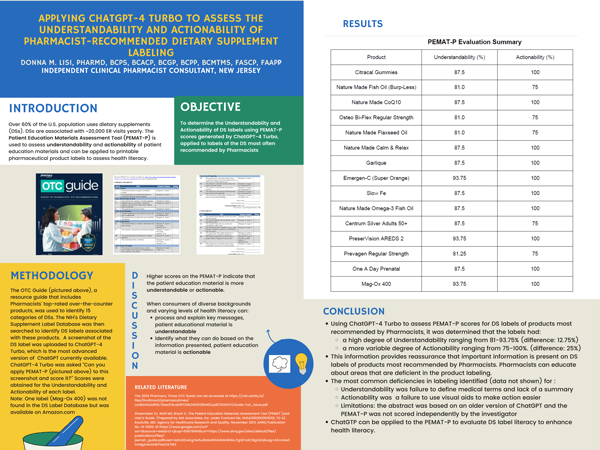
Applying Chat GPT-4 to Assess the Understandability and Actionability of Pharmacist-Recommended Dietary Supplements’ Labeling
Poster abstract: About 60% of adults use dietary supplements (DS). Over 20,000 ER visits yearly are due to DS. The Patient Education Materials Assessment Tool for Printable Materials (PEMAT-P) is an instrument to assess the understandability and actionability of patient educational materials. The OTC Guide contains a list of pharmacist-recommended nonprescription products including DS. This study involves applying Chat GPT-4 to the PEMAT-P to obtain an understandability and actionability score for the most commonly recommended DS by pharmacists for 18 conditions. Understandability and actionability scores ranged from 50-100% but scores > 70% are generally preferred. Implications of the study will be discussed.
|
Donna M. Lisi, PharmD (she/her/hers) Clinical Pharmacist Independent Pharmacist Consultant Somerset, New Jersey, United States |
3rd Place Winner
Teens for Health Literacy: A Teen-led Initiative on a Health Literacy Intervention in Greater Houston
Poster abstract: Teens for Health Literacy is a Houston city-wide club, founded by teens passionate about improving the healthcare system. In partnerships with Health Literacy Lab at UNT Health Science Center and the Houston Health Department, members will give one-hour presentations with interactive stations covering health literacy topics including terminology, access to care, questions to ask during medical visits, and how to better understand medication instructions. In 2025, presentations will be given at libraries and community events focusing on lower English language proficiency and lower socioeconomic groups. A knowledge and confidence survey will be administered before and after the education.
|
Kalyani Pandya Teens For Health Literacy Houston, Texas, United States |
|
Kavan Pandya Teens For Health Literacy Houston, Texas, United States |
|
Teresa Wagner, DrPH, MS, CPH, RD/LD, CPPS, FNAP, CHWI, MSN, RN Associate Professor/Director University of North Texas Health Science Center, College of Public Health/UNTHSC Community Health Worker Training Center Fort Worth, Texas, United States |
|
Melanie Stone, DrPH, MEd, CHWI Assistant Professor/Director The University of Texas Health Science Center at San Antonio San Antonio, Texas, United States |
