Frequently Asked Questions

Scan this page for quick answers to common inquiries.

Who is Healthcare GPS?

HealthcareGPS is revolutionizing healthcare navigation through proprietary AI technology that solves complex benefits distribution challenges. The company transforms how Medicare plans, and employee benefits are selected, compared, and managed, offering unprecedented personalization and transparency. Their innovative approach combines advanced algorithms with deep healthcare expertise to empower brokers, payers, and consumers with intelligent, unbiased guidance. https://healthcaregps.ai/

What Are The Metrics Shown?

The Basic Metrics section provides fundamental text statistics that impact readability:

  • Sentences: Total number of sentences in your document
  • Words: Total word count in your document
  • Complex: Number of complex words (words with 3+ syllables)
  • Complex%: Percentage of complex words relative to total words
  • Words/Sentence: Average number of words per sentence
  • Syllables/Word: Average number of syllables per word

The SMOG Index (Simple Measure of Gobbledygook) is a readability formula that estimates the years of education needed to understand a piece of writing:

  • Grade Level: Indicates the U.S. school grade level needed to comprehend the text
  • Reading Level: Classification of the content’s complexity (e.g., “Standard”)
  • A lower SMOG score indicates text that requires less education to understand
  • Healthcare materials typically aim for a SMOG Index of 6-8 to be accessible to most patients
  • Important: SMOG measures at the 100% comprehension level, meaning the reader fully understands all content

The Flesch-Kincaid metrics provide two key measurements: 

  • Grade Level: The U.S. grade level required to comprehend the text (e.g., 4.5 indicates 4th-5th grade reading level)
  • Reading Ease: A score between 0-100 where higher scores indicate easier readability
    • 90-100: Very easy (5th grade)
    • 80-89: Easy (6th grade)
    • 70-79: Fairly easy (7th grade)
    • 60-69: Standard (8th-9th grade)
    • 50-59: Fairly difficult (10th-12th grade)
    • 30-49: Difficult (College)
    • 0-29: Very difficult (College graduate)
  • Important: Flesch-Kincaid measures at the 75% comprehension level, meaning the reader understands 75% of the content

How Secure is HealthLiteracyCopilot?

HealthLiteracyCopilot provides a secure environment for client documents and content. The system features compartmentalized and segregated storage to protect sensitive information. HealthLiteracyCopilot is SOC2 and HIPAA certified as of February 2025.

HealthLiteracyCopilot is SOC 2 and HIPAA compliant. Each account is secure and private and exists in its own “container” available only to that account. All content, brand-guidelines, custom glossaries, etc., uploaded into the platform, as well as content created by the platform is visible and available only to that account.

AICPA SOC Compliance Logo
HIPAA Compliant Logo

Can We Export the Documents in HealthLiteracyCopilot?

Exporting is available for full assessment, revised text or translated text. All exporting is to a Microsoft Word (.doc) format

AHRQ’s PEMAT

US Department of Health and Human Services Agency for Healthcare Research & Quality’s (AHRQ) Patient Education Materials Assessment Tool (PEMAT) is an instrument to assess the understandability and actionability of print and audiovisual patient education materials.

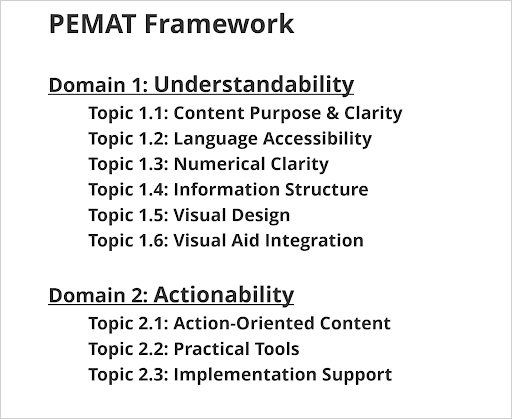
The PEMAT framework:

  • Understandability: Patient education materials are understandable when consumers of diverse backgrounds and varying levels of health literacy can process and explain key messages.
  • Actionability: Patient education materials are actionable when consumers of diverse backgrounds and varying levels of health literacy can identify what they can do based on the information presented.

PEMAT Standards / Scoring

Overall: Understandability score + Actionabiity score (20 possible points)

Understandability: Assesses how well the material enables users to identify and take specific actions to manage their health through clear instructions and practical tools. (15 possible points)

Sub-topics include: Content Purpose & Clarity, Language Accessibility, Numerical Clarity, Information Structure, Visual Design, and Visual Aid Integration. (1-3 possible points each)

Actionability: Evaluates whether the material provides clear, explicit steps and tools that help users take specific health-related actions. (5 possible points)

Sub-topics include: Action-Oriented Content, Practical Tools, and Implementation Support. (1 possible point each)
For technical product or payment help, please use this online support form